Rare Collection
Buy Loose Tourmaline Stones Dubai
Tourmaline
Nature's most colourful gem family, producing every hue in the spectrum.
The Mineralogical Rainbow: A Borosilicate Masterpiece
Tourmaline is arguably the most versatile and chemically complex gem species in the world. As a Complex Borosilicate, its crystal structure can incorporate a vast array of trace elements, resulting in a color spectrum that covers every imaginable hue. This diversity is what led the early Dutch traders to name it "turmali," a Sinhalese word meaning "stone with many colors." From the deep, forest greens of Verdelite to the intense, neon blues of Indicolite and the succulent reds of Rubellite, Tourmaline offers a palette that no other gemstone can match. It is the ultimate playground for nature's chemical experiments.
One of the most remarkable physical properties of Tourmaline is its Pyroelectricity. When heated or rubbed, the crystal develops an electric charge, attracting dust and small particles. Historically, this led to its use by Dutch sailors to pull ash from their Meerschaum pipes, earning it the nickname "Aschentrekker" or ash-drawer. This unique interaction with energy is mirrored in its optical properties; many tourmalines are strongly pleochroic, meaning they must be expertly oriented during cutting to ensure the most vibrant color axis is facing up. This technical complexity makes a masterfully cut Tourmaline a true triumph of gemological engineering.
Brazilian Pegmatites & Global Localities
The world's most legendary tourmalines have historically emerged from the massive pegmatite veins of Minas Gerais, Brazil. These ancient geological structures allowed for the growth of colossal crystals, some reaching several feet in length. Brazil remains the "spiritual home" of the species, producing the world's finest Paraíba specimens and deep, saturated rubellites. However, the last few decades have seen a global expansion of high-quality Tourmaline mining. Namibia has become famous for its "electric" blue-green indicolites, while Nigeria and Mozambique have yielded incredible copper-bearing stones that have redefined the high-end market.
In the United States, the mines of Maine and California were once world leaders, providing stones of such exceptional quality that they were famously favored by the Empress Dowager Cixi of China. This global distribution is a result of Tourmaline's ability to form in both igneous and metamorphic environments, adapting its chemistry to the specific minerals present in the host rock. For the collector, this means that every locality has its own unique "fingerprint," with subtle variations in hue and inclusion patterns that tell the story of the stone's birth millions of years ago.
Market Versatility & The Design Revolution
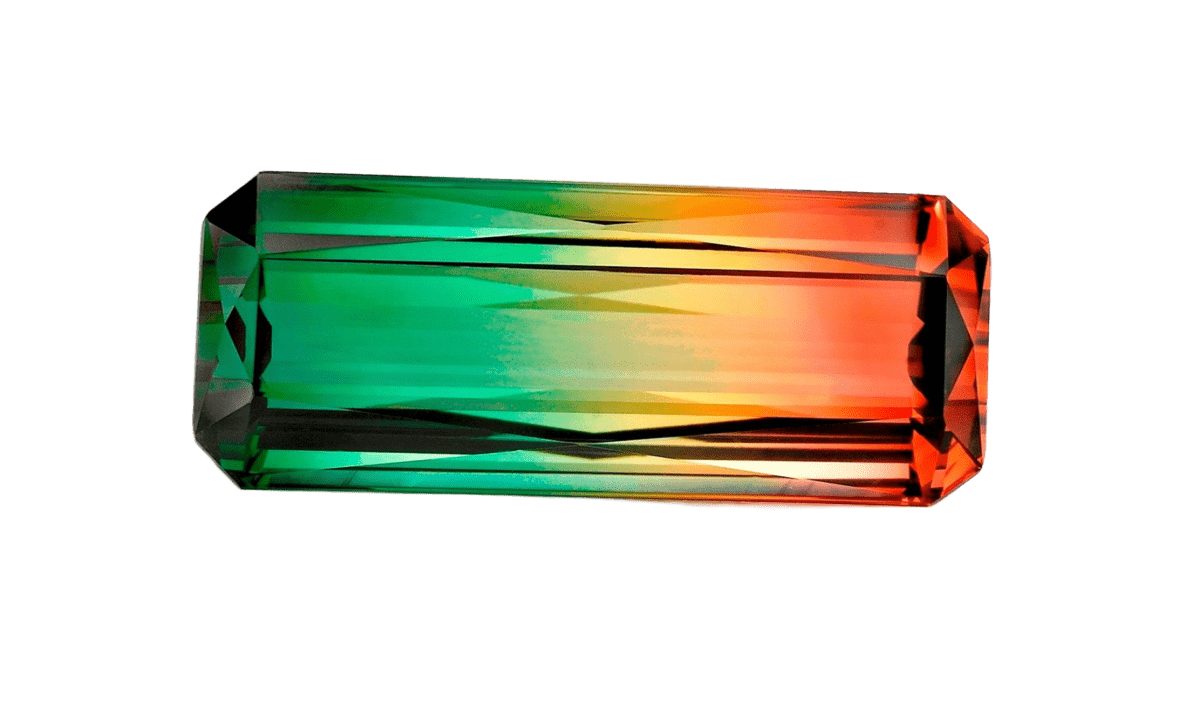
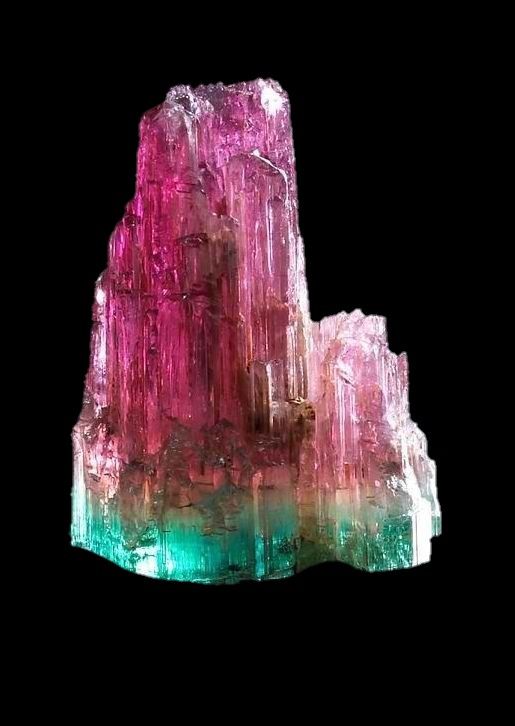
Tourmaline's popularity has undergone a revolution in the 21st century. No longer considered a "semi-precious" substitute, it is now a primary focus for the world's most elite jewelry houses. Its excellent hardness (7.0 to 7.5) and lack of cleavage make it highly durable for all types of jewelry, while its sheer variety of color allows for endless creative expression. Collectors are currently drawn to "bi-color" and "tri-color" tourmalines—stones that show multiple distinct colors in a single crystal—which are increasingly prized for their unrepeatable, painterly aesthetics.
From an investment perspective, certain varieties of Tourmaline have seen price appreciation that rivals the finest sapphires. While Paraíba remains the king of the category, high-quality Rubellite and Indicolite are also experiencing strong demand. For the savvy investor, the key is saturation and clarity. While tourmalines are often naturally more "included" than spinels or aquamarines, finding a clean, vibrant stone over 5 carats is an achievement. As the world continues to move away from standardized luxury toward unique and expressive gemstones, the "rainbow gem" remains a cornerstone of the modern high-end gemstone market.